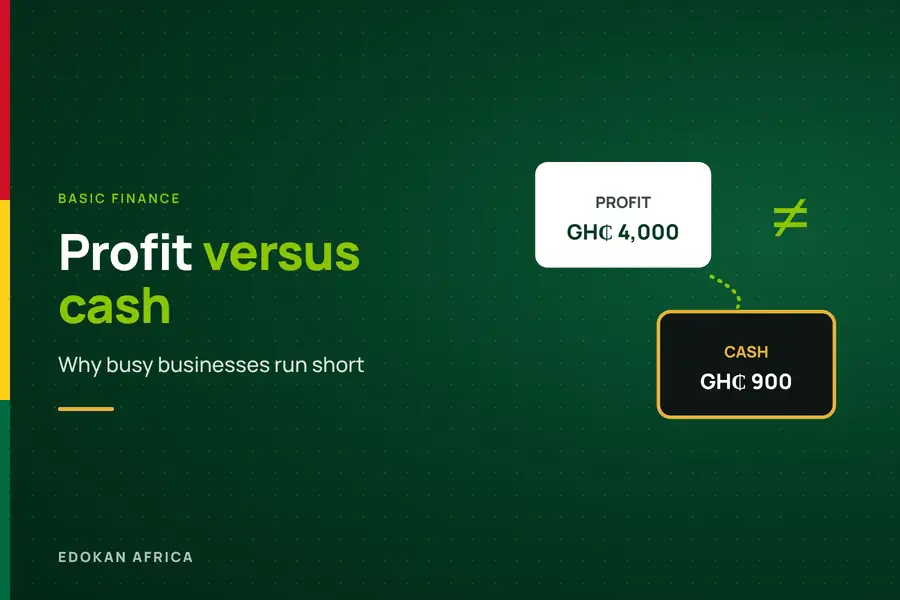
“The shop is busy, so why is there never money?” It is one of the most common worries we hear from business owners. Often the business is profitable on paper, but the cash is stuck somewhere else. Understanding the difference between profit and cash can save your business.
Profit and cash are not the same thing
Profit is what is left after you take all your costs away from your sales over a period, such as a month.
Cash is the money you actually have available right now, in your drawer, mobile money wallet and bank account.
A business can make a profit and still run out of cash. It happens when money goes out before it comes back in.
Where the cash disappears
Customers who buy on credit
You recorded the sale, so it counts towards profit. But until the customer pays, you cannot use that money.
Too much stock on the shelves
Every unsold item is cash sitting still. Buying in bulk to get a discount can make sense, but not if it leaves you unable to pay rent.
Big payments that come once in a while
Rent paid yearly, school fees, annual licences or a new machine can empty the account in one day.
Owners taking money out without a plan
Taking money for home whenever you need it makes it impossible to know what the business can afford.
Growing too fast
A big new order often means buying materials and paying workers weeks before the customer pays you.
Five habits that protect your cash
- Keep a simple cash forecast. List the money you expect to come in and go out each week for the next eight weeks. You will see a shortfall coming before it arrives.
- Agree clear credit terms. Decide who can buy on credit, how much, and for how long. Write it down and follow up on the due date.
- Ask for a deposit on big orders. A deposit of part of the price covers your materials.
- Pay yourself a fixed allowance. Same amount, same day each month. It keeps business money and home money apart.
- Save for big payments. If rent is due once a year, put aside a twelfth of it every month.
A simple example
Ama sells provisions. In October she sells GH₵20,000 of goods and her costs are GH₵16,000, so her profit is GH₵4,000. But GH₵6,000 of those sales were on credit to regular customers, and she bought GH₵3,000 of extra stock for Christmas. At the end of the month her cash is actually lower than when she started, even though she made a profit. Nothing is wrong with her business, but without a plan she could struggle to pay her supplier in November.
Start with good records
You cannot manage cash you cannot see. If you do not have records yet, start with our 15-minute weekly bookkeeping routine. Good records also make you easier to lend to, as we explain in how your cash flow can help you get a loan.
Profit tells you whether your business model works. Cash tells you whether you can survive the next month. Keep an eye on both.