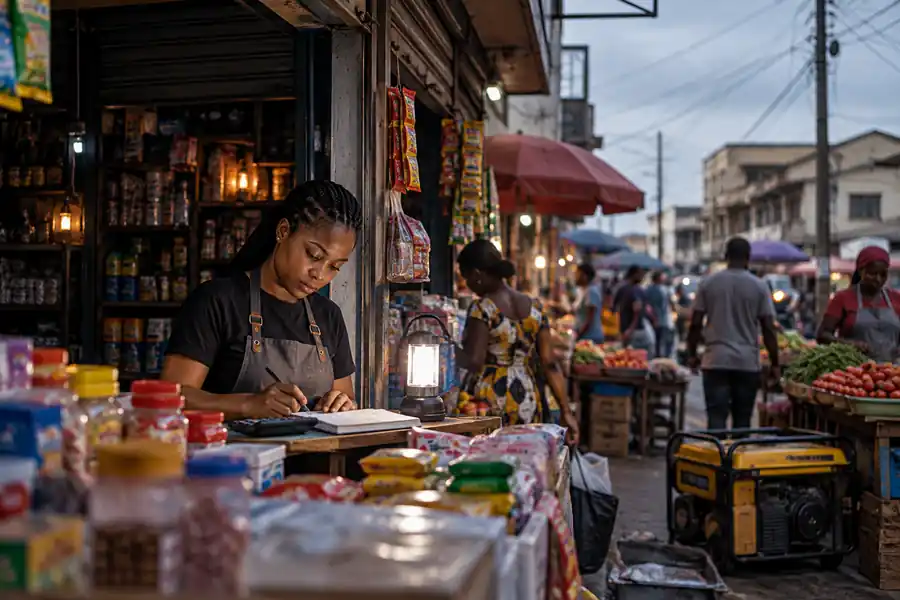
You have no land title. No building to pledge. No car in your name. So when the bank asks for collateral, the conversation ends there.
But you do have something valuable: a steady stream of money moving through your business every week. More and more lenders are willing to lend against that stream. It is called cash-flow lending, and understanding it can open a door that collateral kept shut.
What cash-flow lending means
Cash-flow lending is lending based on your ability to repay out of the money your business brings in. Instead of asking “What can we take if you do not pay?”, the lender asks “Does enough money come in, regularly enough, for you to repay?”
To answer that, the lender looks at your records over time, usually 6 to 12 months:
- Your mobile money statements
- Your bank statements
- Sales records, point-of-sale data or supplier payments
From these, it works out how much you earn on average, how steady that income is, and how much you can safely repay each week or month.
Why it matters for small businesses in Ghana
Across Sub-Saharan Africa, the International Finance Corporation estimates $331 billion in unmet financing demand among micro, small and medium enterprises. A big reason is that most small businesses cannot offer the collateral banks traditionally require.
At the same time, mobile money has become part of daily business life. According to figures reported from Ghana’s Chamber of Telecommunications, registered mobile money accounts reached 74.1 million by February 2025. Every payment through those wallets leaves a record, and that record is exactly what cash-flow lenders read.
Where you will find it
- Mobile money loans: small, short-term loans offered through your wallet, based on your transaction history.
- Digital lenders and loan apps: fintech companies that assess your statements or phone-based data.
- Microfinance and savings and loans companies: many now review mobile money and bank statements when deciding on a loan.
- Banks: some offer working capital or merchant loans to businesses whose sales pass through their accounts or payment terminals.
These loans are usually smaller and shorter than traditional bank loans. They suit stock, supplies and working capital better than big, long-term investments.
What the lender sees in your records
Two businesses can earn the same amount and get very different answers. The difference is usually in how the money moves:
- Consistency: money coming in every week looks safer than a big month followed by empty ones.
- Separation: when business and personal money share one wallet, the lender cannot tell what the business really earns.
- Visibility: sales taken in cash and never deposited are invisible. To a lender, invisible income does not exist.
- Repayment history: repaying small loans on time is how you qualify for bigger ones.
Work out what you can really afford
Example (figures for illustration): Adwoa runs a provisions shop in Kumasi. Around GHS 18,000 passes through her business mobile money wallet each month, and after paying for stock, rent and other costs she keeps about GHS 3,200 profit.
A lender offers her GHS 5,000 over three months, with GHS 700 in fees. She would repay GHS 5,700 in total, or GHS 1,900 a month. That leaves her just GHS 1,300 a month from her profit. If sales dip in a slow month, she could struggle.
A safer choice might be a smaller loan she can repay from a quiet month, not an average one.
Check the true cost. Short loans can look cheap until you compare them fairly. A GHS 70 fee on a GHS 1,000 loan for 30 days sounds small. But repeated over a year, that is GHS 840 on GHS 1,000, or about 84 per cent a year. Always ask for the total amount you will repay and compare lenders on that figure.
Only borrow from licensed lenders
Ghana is tightening the rules on digital lending. Under a Bank of Ghana directive published in 2025, digital credit providers must be licensed, and existing mobile loan apps and digital lenders were given until 30 June 2026 to regularise their operations. The directive also targets harassment by lenders, such as accessing customers’ phone contacts or making unauthorised social media posts about borrowers.
Before you borrow, check that the lender is licensed by the Bank of Ghana, and never give any app access to your contacts.
Start this week
- Open a separate mobile money wallet or bank account used only for your business.
- Push as many sales as you can through it, and deposit cash sales regularly instead of spending them straight away.
- Download your last three months of statements and work out your average monthly income and your lowest month.
- Decide the most you could repay in your weakest month. That is your safe borrowing limit.
- If you borrow, start small, repay on time and check the lender’s licence with the Bank of Ghana.
Sources
- IFC, “MSME Banking in the Digital Era” handbook (2025): ifc.org
- FSD Kenya, “What is cash flow lending”: fsdkenya.org
- Lendsqr, “Bank of Ghana’s new licensing rule for digital lenders” (2025): lendsqr.com
- Bank of Ghana, “Deadline for Existing Mobile Loan Application and Digital Credit Providers” (2025): bog.gov.gh
- TechAfrica News, “Bank of Ghana Unveils Landmark Directive to Regulate Digital Credit Services” (2025): techafricanews.com