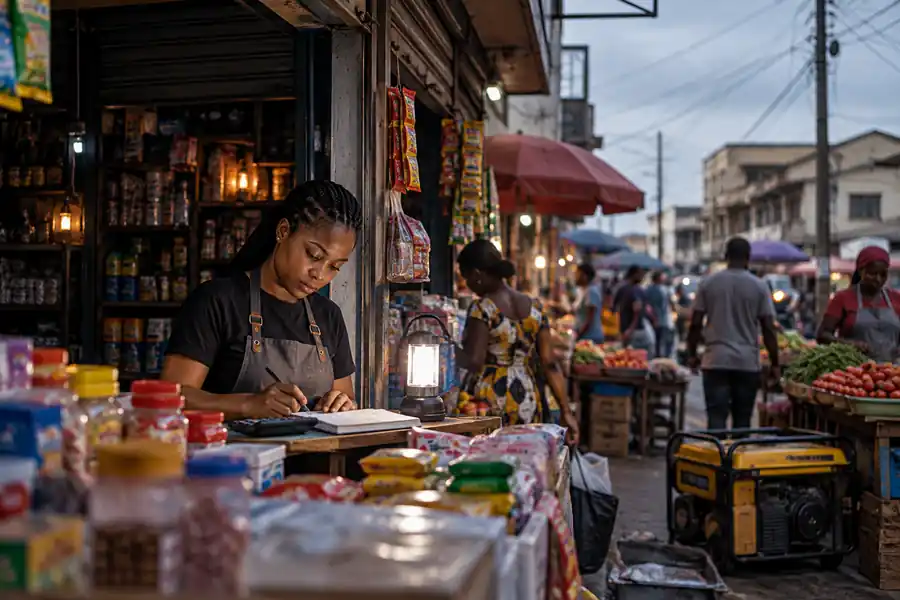
In Ghana they call it dumsor. In South Africa it was load-shedding. In Nigeria, many businesses simply assume the grid will fail and plan around the generator. The name changes from country to country, but the experience is the same for millions of African entrepreneurs: the lights go off, and money walks out of the door.
What outages really cost
It is tempting to think of a power cut as an inconvenience. The research says it is much more than that.
Economists studying firms across sub-Saharan Africa have estimated that unreliable electricity costs the region as much as 2.1 percent of GDP, and that African firms’ total sales are around 4.9 percent lower than they would be with dependable supply. A study using World Bank Enterprise Survey data from 14 African countries went further. It found that if average outage levels were brought down to South Africa’s level at the time, about 118 hours a year, overall firm sales could rise by around 85 percent, and by more than 117 percent for firms without a generator.
Nigeria shows the scale of the problem. World Bank enterprise data reported that 27 percent of Nigerian firms named electricity reliability as their main obstacle, with firms experiencing more than 30 outages in a typical month and losing an estimated 11 percent of sales value as a result.
The losses come from many directions at once: spoiled stock, machines that stop mid-job, customers who leave, staff paid to wait, and fuel bills that eat into already thin margins.
First, measure your own losses
Before spending on a solution, find out what the problem is costing you. For the next four weeks, keep a simple log:
- When the power went off, and for how long.
- What stopped: which machines, which services, which staff.
- What was lost: spoiled goods, missed sales, rework, extra fuel.
At the end of the month, add it up. Many owners are surprised. A cold-store operator may find spoilage is the biggest cost. A tailor may find it is missed delivery dates. A barber may find it is simply customers who do not come back. The answer tells you where to spend.
Practical ways to protect the business
Protect what spoils first
If you sell food, drinks, medicine or anything that needs cooling, spoilage is usually the biggest loss. Keep fridges and freezers full, because a full freezer holds its temperature longer than an empty one. Group perishable stock together, reduce how often doors are opened during outages, and plan smaller, more frequent deliveries so less stock is at risk at any time.
Work with the schedule, not against it
Where utilities publish outage timetables, as South Africa did during load-shedding and Ghana has done at times, plan the power-hungry work for the hours when supply is most likely. Batch ironing, welding, printing or grinding into those windows, and use outage periods for tasks that need no power: sorting stock, cleaning, customer follow-ups, bookkeeping.
Right-size your backup
Many businesses buy the biggest generator they can afford and then spend a fortune on fuel. Start from your log: which equipment must run during an outage? Often it is only a fridge, lights, a card or mobile money terminal and a phone charger. A smaller generator, or a battery and inverter for the essentials, can cost far less to run than powering everything.
Look seriously at solar
Solar costs have fallen dramatically, and across Africa small businesses are adopting solar kits, solar-and-battery systems and shared mini-grids in markets and industrial clusters. For daytime businesses, solar can cover a large share of needs. Pay-as-you-go solar providers in several African countries let businesses pay in instalments instead of upfront. Get at least two quotes, ask for the expected output for your location, and check the warranty on batteries, which usually fail first.
Protect your equipment
The surge when power returns can damage machines and electronics. Surge protectors and voltage stabilisers are cheap compared with replacing a freezer or laptop.
Share the cost
In markets, workshops and shopping centres, neighbouring businesses can share a generator or a solar installation and split the running costs. It is the same logic as a group loan: together, a solution becomes affordable that none could manage alone.
Price it in, honestly
If backup power is a permanent part of running your business, it is a real cost and belongs in your prices. Work out your monthly fuel or solar repayment, divide it across your expected sales, and include it. Customers generally understand that businesses face these costs; what hurts you is absorbing them silently until the business can no longer breathe.
The bigger picture
Reliable electricity is a policy problem, and businesses are right to demand better from governments and utilities. But while that fight continues, the businesses that survive are the ones that measure their losses, protect what matters most and plan around the grid rather than hoping it will hold. Start with the four-week log. It costs nothing, and it will tell you exactly where your money is going when the lights go off.
Sources
- Cole, Elliott, Occhiali & Strobl, “Power outages and firm performance in Sub-Saharan Africa”, Journal of Development Economics (2018), including estimates by Eberhard et al.: sciencedirect.com
- “Electricity supply and use among rural and peri-urban households and small firms in Nigeria”, citing the World Bank Nigeria Enterprise Survey: arxiv.org
- World Bank, “Value lost due to electrical outages (% of sales for affected firms)”: data.worldbank.org