On 6 October 2026, Foreign Affairs Minister Samuel Okudzeto Ablakwa announced that the Cabinet had approved a formal application for Ghana to join BRICS. Ten days later, President John Dramani Mahama called the move a deliberate strategy to widen Ghana’s partnerships and deepen South-South cooperation, while keeping its long-standing ties with traditional partners.
For a business owner, the real question is simple: what changes for me? This guide sets out what has actually been decided, what BRICS can and cannot do, and the likely pros and cons for businesses in Ghana.
First, what has actually happened
- Ghana has decided to apply, not joined. Admission needs the agreement of the existing members, and no timeline has been announced.
- Partner country, not full member. On 10 October 2026, Mr Ablakwa clarified that Ghana is applying for “partner country” status, the same status held by Nigeria and Uganda, and is not seeking full membership.
- Traditional partners stay. The government has said BRICS will not replace existing relationships and has restated its commitment to the IMF, the World Bank and African financial institutions.
- Parliament wants details. The Minority has asked for an urgent briefing, and a cost-benefit analysis has not been published.
What BRICS is today
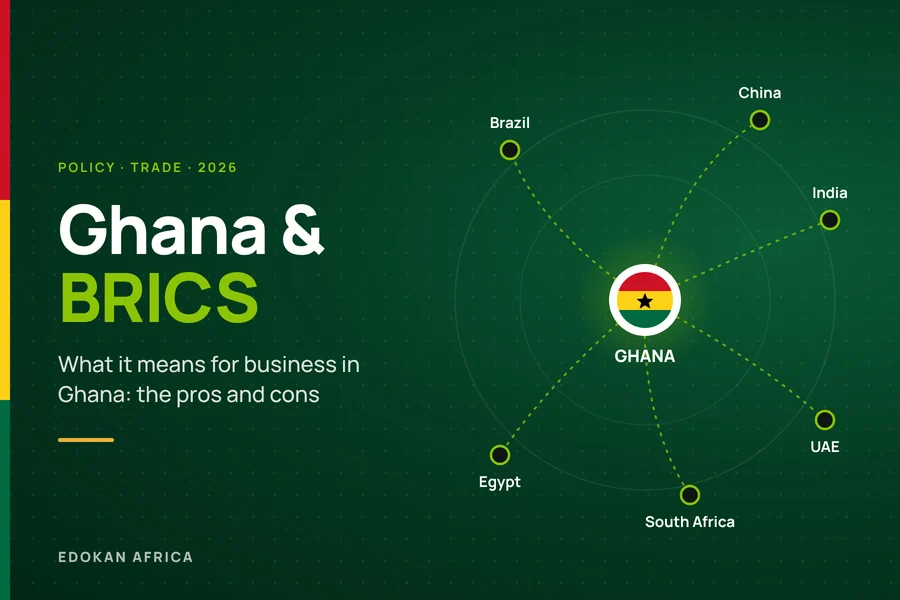
BRICS began as Brazil, Russia, India and China, with South Africa joining in 2010. After expansions in 2024 and 2025 it has 11 full members: Brazil, China, Egypt, Ethiopia, India, Indonesia, Iran, Russia, Saudi Arabia, South Africa and the United Arab Emirates. Ten more countries, including Nigeria and Uganda, are partner countries.
BRICS is not a free trade area or a customs union. Joining does not automatically cut import duties, create a common currency or bring new loans. Its main tools are summits, cooperation agreements, work on paying for trade in local currencies, and a development lender, the New Development Bank (NDB).
Why it matters: where Ghana already sells
Much of Ghana’s trade already goes to BRICS countries. JoyNews Research notes that four of Ghana’s five largest export destinations in 2025 were BRICS members: the UAE, India, South Africa and China. The fifth was Switzerland. An analysis on 3News put their combined share at about 57% of export earnings, much of it gold.
So for many exporters, BRICS partner status would formalise relationships that already exist rather than open completely new markets.
The possible benefits for Ghanaian businesses
1. More options for finance
Ghana is coming out of a debt crisis. The IMF completed the final review of its roughly US$3 billion programme in July 2026. BRICS ties could give government and large projects more places to look for funding, including the New Development Bank. Over time this can mean more infrastructure such as roads, rail and power, which lowers costs for every business.
2. Paying for trade without always using dollars
BRICS is pushing payment links that let countries trade in their own currencies. 3News reports that Stanbic Bank Ghana is already piloting cedi-yuan settlement. For importers who buy from China or India, this could eventually mean fewer dollar shortages and lower conversion costs.
3. Closer ties with India and China
During the announcement, Ghana and India signed agreements on agriculture, science and technology, agricultural research and biodiversity, and discussed railways, pharmaceuticals, ICT, health, mining and digital technology. These areas could bring partnerships, training and supply opportunities for local firms.
4. A push for value addition
The government says BRICS could open wider markets for processed cocoa, gold and oil products. Businesses that process, package and brand products locally, rather than exporting raw materials, stand to gain most if this happens.
5. Spreading risk
Relying on a few partners is risky, as the recent changes to US aid and trade policy showed. More relationships give Ghana more room to negotiate.
The possible risks and downsides
1. Friction with the United States
In July 2025, US President Donald Trump threatened an extra 10% tariff on countries “aligning themselves with the Anti-American policies of BRICS”, and earlier threatened 100% tariffs if BRICS tried to replace the dollar. Neither threat is an automatic tariff on countries that join, and a US official told Reuters any tariff would depend on policy actions. But the risk is real for businesses that sell to the US.
The timing is sensitive. The US duty-free trade programme AGOA was renewed only until 31 December 2026, and its future is undecided. Exporters of garments, processed foods and other goods to the US should watch this closely.
2. More cheap imports
Ghana already buys far more from China than it sells there. Closer ties could bring cheaper machinery and inputs, which helps some businesses, but also more competition for local manufacturers and traders selling similar goods.
3. Membership does not guarantee money or markets
BRICS membership does not automatically bring loans or New Development Bank membership. Countries such as Bangladesh, Algeria, Colombia and Uzbekistan have joined the NDB without being BRICS members. Some benefits are also already available without BRICS. For example, since 1 May 2026, China has applied zero tariffs to imports from all African countries it has diplomatic ties with, including Ghana.
4. A divided group
BRICS members include countries with very different interests, such as Russia, Iran, India, China and the UAE. Agreement is often slow. There is no BRICS common currency, and the 2026 summit backed local-currency payments rather than a new currency.
5. Little detail so far
No costs, timeline or specific benefits have been published. Until they are, businesses should treat BRICS as a long-term possibility, not a change that affects them tomorrow.
Pros and cons at a glance
| Possible benefits | Possible risks |
|---|---|
| More sources of development finance | US tariff threats and an uncertain AGOA future |
| Trade paid in local currencies | More cheap imports competing with local firms |
| Closer links with India and China | No automatic loans, markets or tariff cuts |
| Support for value addition | A divided group that moves slowly |
| Less reliance on a few partners | Costs and benefits not yet published |
What should a business owner do now?
- Do not change plans overnight. Ghana has applied, not joined, and nothing changes for trade rules today.
- If you sell to the US, follow the AGOA renewal and any tariff news, and look at other markets as a back-up.
- If you import from China or India, ask your bank about local-currency payment options as they become available.
- Look at value addition. Processed, packaged and branded products are where new markets are most likely to open.
- Use what already exists, such as China’s zero-tariff treatment and the African Continental Free Trade Area. Our guide to AfCFTA in plain language explains how.
BRICS could become a useful extra door for Ghanaian business, especially for finance and trade with Asia. But it is one door among several, and the businesses that benefit will be those with good records, quality products and the readiness to sell in more than one market.
This article is for general information and reflects public reports as of 18 October 2026. It is not legal, trade or investment advice.
Sources
- Citi Newsroom, “Ghana to formally apply to join BRICS – Ablakwa” (6 October 2026): citinewsroom.com
- Graphic Online, “Ghana not seeking full BRICS membership, applying as Partner Country – Ablakwa” (October 2026): graphic.com.gh
- Graphic Online, “Ghana seeks wider trade and investment opportunities through BRICS” (16 October 2026): graphic.com.gh
- Ghana News Agency, “Ghana to apply for BRICS membership – Ablakwa” (October 2026): gna.org.gh
- 3News, “Ghana and BRICS: Strategic optionality or an expensive signal?” (October 2026): 3news.com
- JoyNews Research, “Ghana risks 10% to 100% tariffs on exports to US under Trump’s threats as it moves to join BRICS” (12 October 2026): myjoyonline.com
- Capital FM, “Trump signs law reauthorizing AGOA trade program through 2026” (February 2026): capitalfm.africa
- Capital FM, “China’s zero-tariff treatment for all African countries with diplomatic ties takes effect on May 1” (2026): capitalfm.africa
- News On AIR, “Colombia and Uzbekistan join NDB ahead of 17th BRICS summit” (July 2025): newsonair.gov.in