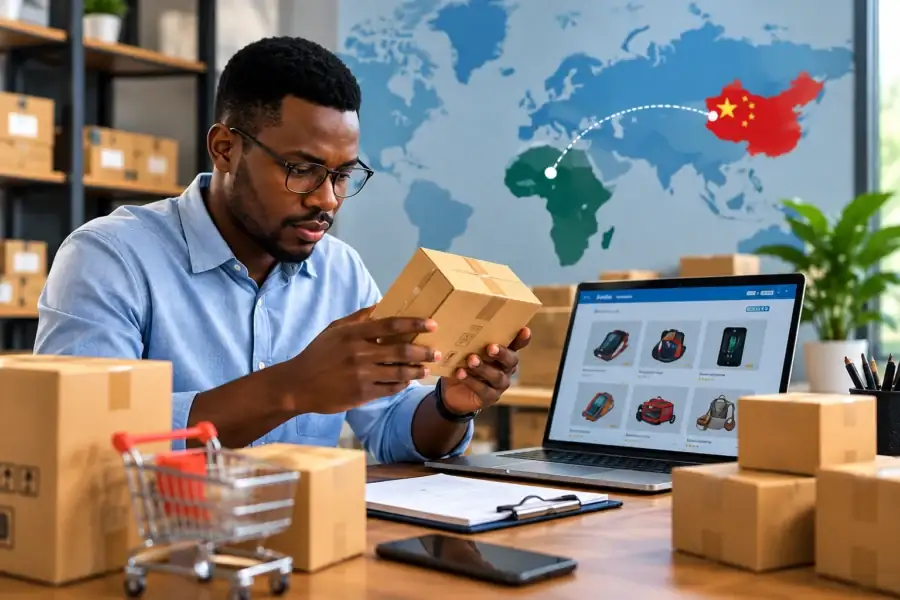
Thousands of Ghanaian traders buy from China every year. A trader in Accra finds a supplier online with excellent prices. The chats are friendly, the photos look good, and she sends the full payment to secure a discount. Six weeks later the container arrives. Half the goods are a lower grade than the samples in the photos, and the supplier has stopped replying.
Stories like this are common, but most import losses come from a handful of avoidable mistakes. Here is a step-by-step way to buy from China with far less risk.
Step 1: Check that the supplier is real
- Ask for the business licence. Check that the company name on the licence matches the name on the invoice and on the bank account you will pay into.
- Ask for a video call from the factory or warehouse. A real manufacturer can show you its production line. A trading company is fine too, as long as it is honest about what it is.
- Look at its history. How many years has it been trading? Can it give you contacts of other buyers, ideally in West Africa?
- Be very careful with bank details. Never pay into a personal account. If you receive an email saying the supplier’s bank account has changed, confirm it by video or phone before paying. Changed-account scams are one of the most common ways importers lose money.
- Check it independently. Search the company name on China’s National Enterprise Credit Information Publicity System (gsxt.gov.cn), or pay a verification company for a short report. Do not rely only on badges on a trading platform.
Step 2: Order samples first
Pay for samples before placing a big order, and keep them. The samples become your reference point. If the main order is different, you have physical proof of what was agreed.
Step 3: Put everything in writing
Your proforma invoice or purchase contract should state clearly:
- the exact product specifications, model numbers, materials and colours;
- quantity, packaging and labelling;
- the production and shipping dates;
- the price, currency and payment terms;
- the delivery term (see Step 4); and
- what happens if the goods do not match the samples or the specifications.
Chat messages help, but a signed document that lists these points is much stronger if a problem comes up.
Step 4: Know who pays for what
International traders use short codes called Incoterms, published by the International Chamber of Commerce, to agree who pays for transport and insurance, and where the risk passes from seller to buyer. The common ones in plain words:
- EXW (Ex Works): you collect the goods from the factory. You handle almost everything, including Chinese export clearance.
- FOB (Free On Board): the supplier delivers the goods onto the ship at a Chinese port. You pay sea freight and insurance from there.
- CIF (Cost, Insurance and Freight): the supplier pays freight and basic insurance to your port, such as Tema. The risk still passes to you once the goods are loaded in China, and the insurance is usually the minimum, so consider taking out better cover yourself.
- DAP (Delivered At Place): the supplier arranges delivery to an agreed place in Ghana, but you pay the import duties and taxes.
Always compare quotes on the same term. A cheap EXW price can end up costing more than a higher CIF price.
Step 5: Pay in a way that protects you
- Deposit and balance: a common pattern is 30 per cent to start production and 70 per cent before shipping. Do not pay the balance until the goods have been inspected.
- Letter of credit: for larger orders, your bank pays the supplier only when agreed documents, such as an inspection certificate, are presented. It costs more in bank fees but gives strong protection.
- Platform payment protection: some trade platforms hold your payment until delivery terms are met. Read the rules carefully before relying on them.
- Supplier credit: established importers can sometimes get 30 to 90 days to pay. Our article on Sinosure and Chinese payment terms explains how that works and what it really costs.
- Know the limits: a letter of credit checks documents, not goods. If the documents match, the bank pays even if the goods are poor, which is why an independent inspection certificate should be one of the required documents. Platform protection usually has strict time limits and claim rules.
Step 6: Inspect before you pay the balance
Independent inspection companies in China will check your goods at the factory before shipment. They count the goods, compare them with your samples and specifications, test a portion and send you a report with photos. The fee is small compared with the cost of receiving a container of the wrong goods.
Write the inspection into your contract, so the supplier knows the balance is paid only after a passed inspection.
Check Ghana’s import rules too
Some products need approval before they can be imported or sold in Ghana, for example food, cosmetics and medicines (Food and Drugs Authority) and many electrical and building products (Ghana Standards Authority). Check with the relevant authority and your clearing agent before you order, not after the goods arrive.
Step 7: Work out your true landed cost
The factory price is only the start. Your landed cost is everything you pay to get the goods into your shop:
- product cost;
- sea or air freight and insurance;
- import duties, taxes and levies;
- port, shipping line and clearing agent charges;
- transport from the port to your warehouse; and
- a buffer for exchange rate movements between ordering and paying.
Example (figures for illustration): Yaw orders 200 office chairs at US$30 each FOB, which is US$6,000. Freight and insurance to Tema come to US$1,500. Duties, taxes, port and clearing charges come to US$2,700, and trucking to Kumasi costs US$300. His total landed cost is US$10,500, or US$52.50 per chair, not US$30. Yaw sets his selling price from the US$52.50.
Also check before you order whether your product needs approval in Ghana. Food, cosmetics and medicines are regulated by the Food and Drugs Authority, and some other goods must meet Ghana Standards Authority requirements. Finding out after the goods land is expensive.
Your checklist before you buy from China
- Ask your current or new supplier for its business licence and a short video call from the factory floor.
- Write down the full specifications for your next order and attach them to the proforma invoice.
- Ask for prices on the same Incoterm from at least two suppliers.
- Get a quote from an inspection company for your next order.
- Build a simple landed-cost sheet before you agree a price.
This article is general information, not legal or financial advice. Check current import rules and charges with your clearing agent and the relevant authorities before ordering.
Sources
- International Chamber of Commerce, Incoterms rules: iccwbo.org
- Food and Drugs Authority, Ghana: fdaghana.gov.gh
- Ghana Standards Authority: gsa.gov.gh